

 español


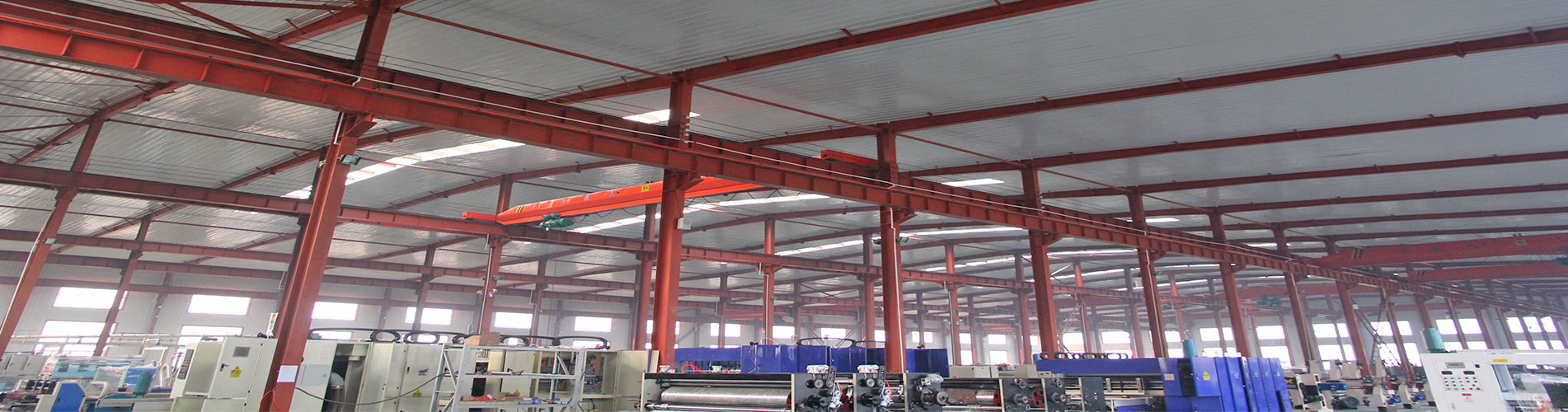

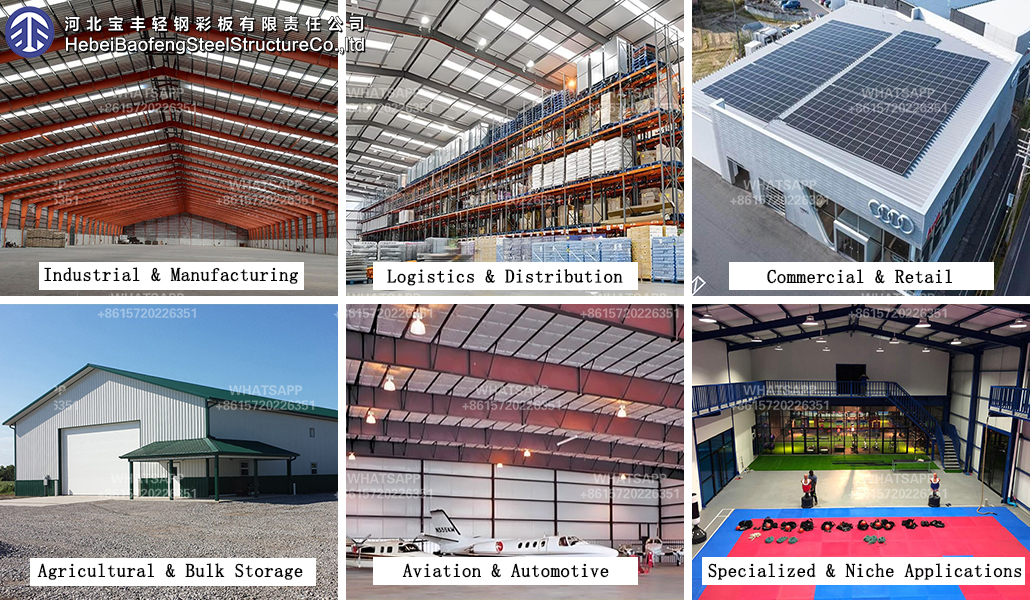
Steel warehouses are suitable for a wide range of applications
Steel warehouses are highly versatile and suitable for a wide range of applications due to their inherent strengths. Their adaptability stems from the clear-span design (no interior columns), ease of expansion, and customizable features.
Here’s a breakdown of their most common and suitable applications:
1. Industrial & Manufacturing
Factories & Assembly Plants: Provide large, unobstructed floorspace for production lines, heavy machinery, and inventory staging.
Workshops & Repair Bays: Ideal for automotive, machinery, or equipment repair with high ceilings for lifts and cranes.
Raw Material & Component Storage: Store bulk materials, palletized goods, and parts in a secure, organized environment.
2. Logistics & Distribution
Distribution Centers (DCs) & Fulfillment Centers: The backbone of e-commerce and supply chains. Designed for high-volume receiving, sorting, and shipping, often incorporating mezzanines and advanced racking systems.
Freight & Trucking Terminals: Serve as hubs for cross-docking, trailer loading/unloading, and temporary freight storage.
Cold Storage & Refrigerated Warehouses: Can be insulated and clad with special panels to create temperature-controlled environments for food, pharmaceuticals, and perishable goods.
3. Commercial & Retail
Big-Box Retail & Wholesale Clubs: (e.g., Home Depot, Costco). The building itself is often a large steel warehouse with a retail front.
Showrooms & Indoor Sales Lots: For vehicles, boats, RVs, or large equipment, combining storage and display.
Back-of-House Storage: Attached or separate storage for retail inventory.
4. Agricultural & Bulk Storage
Grain Silos & Feed Storage: Often use specific corrugated steel panels for silos and bunkers.
Equipment Storage: Shelter for tractors, combines, and other large farm machinery from the elements.
Processing & Packing Facilities: For sorting, packaging, and storing produce or other agricultural products.
5. Aviation & Automotive
Aircraft Hangars: Require very wide clear-spans and high doors. Steel is the default material for hangars.
Dealership Storage & Service Centers: For vehicle inventory and service bays.
Bus & Fleet Vehicle Storage.
6. Specialized & Niche Applications
Sports & Recreation: Indoor soccer facilities, tennis centers, riding arenas, and recreational vehicle storage.
Municipal & Utility: Salt sheds for road maintenance, fire stations, vehicle and equipment storage for municipalities, and utility company depots.
Self-Storage Facilities: Easily subdivided into secure, individual units.
Data Centers: Increasingly popular due to the need for vast, column-free spaces for server racks, with reinforced floors for heavy loads.
Key Advantages Making Steel Warehouses Suitable for These Uses:
Cost-Effectiveness: Lower initial cost per square foot and faster construction time (quick ROI).
Durability & Low Maintenance: Resistant to pests, rot, and (with proper coatings) corrosion. Requires minimal upkeep.
Design Flexibility: Easily customized for door placements (overhead, dock-high), ceiling height, lighting, insulation, and interior layout.
Scalability: Can be expanded in length or width relatively easily to accommodate business growth.
Strength & Safety: Can support heavy mezzanines, crane systems, and roof-mounted equipment like HVAC or solar panels.
Conclusion
The steel warehouse is not a one-size-fits-all solution, but a highly adaptable building system. Its core benefits of strength, span, speed, and scalability make it the dominant and most suitable choice for virtually any application that requires a large, secure, and functional enclosed space for storage, commerce, or industry.
Categorías
último blog
Etiquetas


Para Consultas sobre nuestros productos o su lista de precios, por favor, déjanos a nosotros y estaremos en contacto dentro de las 24 horas.
© Derechos de autor: 2026 Hebei Baofeng Steel Structure CO.,LTD Reservados todos los derechos.

IPv6 red apoyada


 +8615720226351